
Monday, May 19, 2008
The girl who silenced the world for 5 minutes
She addressed a UN Meeting on issue of environment
Added: May 17 2008(2 days ago)
Duration: 06:42
This is a YouTube Video.
Monday, May 19, 2008 0
Saturday, May 17, 2008
We humans are created equal, are having something in common. Our DNA proves that fact. Now stop killing in the name of cast, creed, religion, nationality. Our earth is equal for us.
!!!STOP KILLINGS OF FELLOW HUMANS FOR ANY CAUSE!!!
The Genographic project links our DNAs are quoted from Africa. We all have started from there. Watch this National Geographic Video.
This page has an embeded video object. It may take time to load.
Saturday, May 17, 2008 0
Wednesday, May 14, 2008
Forty five species of flora are facing extinction in Sikkim, a Botanical Survey of India (BSI) report has said.
Plant species like aconitum ferox, dioscorea deltoid, pseudotenesa, acronema and ephedra gerrardiana are some that are endangered, senior BSI scientist Mr Kanad Das said.
The findings came to light recently when a BSI team undertook an exercise to update the status of the flora species in Sikkim. The survey was in particular aimed at identifying the endemic, endangered and threatened species of the flora in the Himalayan state, Mr Das said, adding the status of the floral species in Sikkim on the basis of the latest survey would be sent to the Centre.
The BSI has infrastructure, including nurseries, to preserve various floral species and so if any particular species of flora faces threat of extinction then preserved ones could replace such plants, Mr Das said.
Sikkim has about 4,400 varieties of flora species. - PTI
News Courtesy & Thanks :- The Hindu
Wednesday, May 14, 2008 1

Some 60 giant pandas at a Chengdu research centre near the worst hit part of the massive China earthquake are safe, Xinhua reported on Tuesday.
But there was no word yet on the fate of pandas at another research centre at Wolong, near the epicentre of Monday's 7.9 magnitude quake.
At least 10,000 people died and the toll is likely to soar following the quake in Sichuan province.
The giant panda is one of the world's most endangered species and is found only in China. It has become an international wildlife symbol and an icon for the Olympic games to be held in Beijing in August.
An estimated 1,600 pandas live in nature reserves in Sichuan province and neighboring Gansu and Shanxi.
(Reporting by Emma Graham-Harrison; Editing by Ken Wills)
News source & Courtesy: Reuters

Debris strewn at Badi Chaupar, one of the sites of a series of bomb blasts which tore through crowded markets. [AFP]
Up to seven bombs have ripped through the north western Indian tourist city of Jaipur, killing at least 80 people and injuring scores of others.
The city is a top tourist spot in India and is often frequented by overseas visitors.
The bombs were detonated in quick succession over just 12 minutes as people were doing their evening shopping.
One bomb exploded near Jaipur's best known tourist attraction, the historic Hawa Mahal or Palace of Winds.
Read more here
Tuesday, May 13, 2008

The first cyclone of the 2008 season in the northern Indian Ocean was a devastating one for Myanmar (Burma). According to reports from Accuweather.com, Cyclone Nargis made landfall with sustained winds of 130 mph and gusts of 150-160 mph, which is the equivalent of a strong Category 3 or minimal Category 4 hurricane. News reports stated that at least 10,000 people were killed, and thousands more were missing as of May 5.
Flood water can be difficult to see in photo-like satellite images, particularly when the water is muddy. This pair of images from the Moderate Resolution Imaging Spectroradiometer (MODIS) on NASA’s Terra satellite use a combination of visible and infrared light to make floodwaters obvious. Water is blue or nearly black, vegetation is bright green, bare ground is tan, and clouds are white or light blue.
On April 15 (top), rivers and lakes are sharply defined against a backdrop of vegetation and fallow agricultural land. The Irrawaddy River flows south through the left-hand side of the image, splitting into numerous distributaries known as the Mouths of the Irrawaddy. The wetlands near the shore are a deep blue green. Cyclone Nargis came ashore across the Mouths of the Irrawaddy and followed the coastline northeast. The entire coastal plain is flooded in the May 5 image (bottom). The fallow agricultural areas appear to have been especially hard hit. For example, Yangôn (population over 4 million) is almost completely surrounded by floods. Several large cities (population 100,000–500,000) are in the affected area. Muddy runoff colors the Gulf of Martaban turquoise.
The high-resolution image provided above is at MODIS’ maximum spatial resolution (level of detail) of 250 meters per pixel. The MODIS Rapid Response Team provides twice-daily images of the region in additional resolutions and formats, including photo-like natural color.
NASA images courtesy the MODIS Rapid Response Team. Caption by Rebecca Lindsey.
Source: Wikipedia
Tuesday, May 13, 2008 0
CHONGQING, China (AP) — One of the worst earthquakes in decades struck central China on Monday, killing nearly 9,000 people, trapping about 900 students under the rubble of their school and causing a toxic chemical leak, state media reported.
The 7.8-magnitude earthquake devastated a hilly region of small cities and towns. The official Xinhua News Agency said 8,533 people died in Sichuan province and more than 200 others were killed in three other provinces and the mega-city of Chongqing.
Xinhua said 80 percent of the buildings had collapsed in Sichuan province's Beichuan county after the quake, raising fears the overall death toll could increase sharply.
The quake hit about 60 miles northwest of Chengdu — a city of 3.75 million — in the middle of the afternoon when classrooms and office towers were full. There were several smaller aftershocks, the U.S. Geological Survey said on its Web site.
The earthquake, China's deadliest since 1976, occurred in an area with numerous fault lines that have triggered destructive temblors before. A magnitude 7.5 earthquake in Diexi, Sichuan that hit on August 25, 1933 killed more than 9,300 people.
About 1,200 pandas — 80 percent of the surviving wild population in China — live in several mountainous areas of Sichuan.
The earthquake hit one of the last homes of the giant panda at the Wolong Nature Reserve and panda breeding center, in Wenchuan county, which remained out of contact, Xinhua said.
The Wolong PandaCam, a live online video feed showing the activities of the pandas at the nature reserve, stopped showing footage of the animals late Sunday night.
The earthquake also rattled buildings in Beijing, some 930 miles to the north, less than three months before the Chinese capital was expected to be full of hundreds of thousands of foreign visitors for the Summer Olympics.
Skyscrapers swayed in Shanghai and in the Taiwanese capital of Taipei, 100 miles off the southeastern Chinese coast. There were no immediate reports of injuries or damage.
The quake was felt as far away as the Vietnamese capital of Hanoi, where some people hurried out of swaying office buildings and into the streets downtown. A building in the Thai capital of Bangkok also was evacuated after the quake was felt there.
A magnitude 7.8 earthquake is considered a major event, capable of causing widespread damage and injuries in populated areas.
The last serious earthquake in China was in 2003, when a 6.8-magnitude quake killed 268 people in Bachu county in the west of Xinjiang.
More Photos:
A man walks down a staircase full of debris inside a hospital after an earthquake in Chengdu of southwest China's Sichuan province, Monday, May 12, 2008. Thousands of soldiers and police were dispatched to central China after a massive earthquake Monday killed at least 107 people and buried nearly 900 schoolchildren. (AP Photo/Color China Photo)
In this photo distributed by the official Xinhua news agency, people look upwards after running out of high buildings in Nanjing, northwest China, after a powerful, magnitude 7.8 earthquake struck mountainous central China on Monday May 12, 2008. (AP Photo/Xinhua, Han Yuqing)
In this photo distributed by the official Chinese news agency, people try to find their property among the debris of collapsed buildings in Dujiangyan, in southwest China's Sichuan Province, on Monday May 12, 2008. A major earthquake measuring 7.8 on the Richter scale jolted Wenchuan County of Sichuan Province on Monday, leading to the collapse of many buildings in the neighbouring city of Dujiangyan, Xinhua said. (AP Photo/Xinhua, Chen Xie)
In this photo distributed by the official Xinhua news agency, rescuers try to save wounded students at Juyuan Middle School in Juyuan Township of Dujiangyan City, about 100 kilometers from the epicenter in Wenchuan county of southwest China's Sichuan province, on Monday May 12, 2008. Nearly 900 students here were feared buried when a high school building collapsed in the earthquake, Xinhua said. (AP Photo/Xinhua, Chen Xie)
In this photo distributed by the official Xinhua news agency, rescuers search for students at Juyuan Middle School in Juyuan Township of Dujiangyan City, about 100 kilometers from the epicenter in Wenchuan county of southwest China's Sichuan province, on Monday May 12, 2008. Nearly 900 students here were feared buried when a high school building collapsed in the earthquake, Xinhua said. (AP Photo/Xinhua, Chen Xie)
Monday, May 12, 2008
A small temple sits partially submerged in a rice field near the remains of a house destroyed by last weekend's devastating Cyclone Nargis.
On Thursday the UN's World Food Programme said its first flight carrying aid to cyclone victims had received clearance from Myanmar's ruling military junta.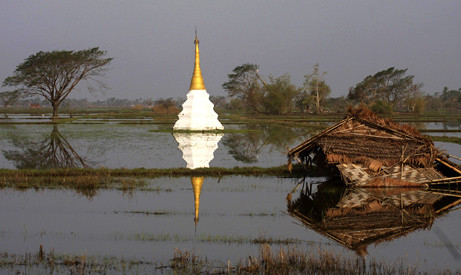
Photograph by AP
But the UN halted shipments the next day after the junta seized 38 tons of supplies, saying it planned to distribute them under its own efforts, the Associated Press reported.
Unofficial death is estimated more than 50000 and Corpses can be seen everywhere. Survivors cannot find food or water, local sources said that diarrhea has now affected a great number of people in the Irrawaddy Delta due to infection from corpses and dead fish. Source said that no aid from either the Burmese government or non-governmental organizations has been received in Laputta Township to date. The cyclone Nargis hit Laputta Township on May 2 at about 2 a.m. when most people were sleeping,high wind storm continued throughout the night.
Monday, May 12, 2008 0
Eight critically endangered Amur leopards (including the animal above) have been photographed by a camera trap in far southeastern Russia.
Fewer than 40 Amurs—also called Far Eastern leopards—still prowl the temperate forests of Russia's Far East and parts of China, making the Amur the world's rarest big cat. 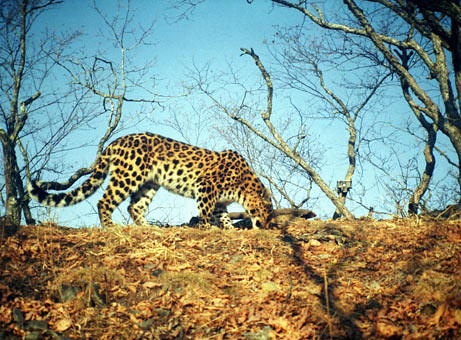
Eight of the animals were captured on film in the Primorskiy region of Russia, which borders China and North Korea, during a recent census.
The research was conducted by the conservation group WWF and a local nonprofit, the Institute for Sustainable Use of Natural Resources.
"The confirmed stability of the leopard population … warm[s] our hearts and give[s] hope," Pavel Fomenko of WWF Russia said in a statement.
"But this is only a small part of the leopard's habitat in the southwest Primorskiy. The remaining 70 percent of the leopard's habitat [is] in precarious condition," Fomenko added.
Though the Russian government adopted a conservation strategy for the predator in 1998, poaching driven by an illegal trade in leopard parts is still a threat, according to WWF.
The conservation group has supported anti-poaching activities and tried to increase the population of hoofed prey species in the leopard's habitat.
"The goal of utmost importance is to create a unified federal protected area for the leopard," Fomenko said, "[and that] has not yet been achieved in Primorskiy."
Sunday, May 11, 2008
After 9,000 years of silence, Chile's Chaitén volcano (pictured on May 3) is erupting with lava, ash—and lightning (full story).
Since the volcano awoke on May 2, it has continued erupting intermittently, blanketing the area in ash and forcing more than 4,000 people to flee.
Chile Volcano erupting with Ash, Lava, Lightning
Photograph by Carlos Gutierrez/UPI/Landov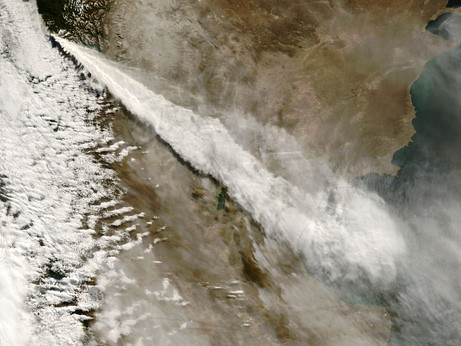
Chile Volcano erupting with Ash spreading
Image by NASA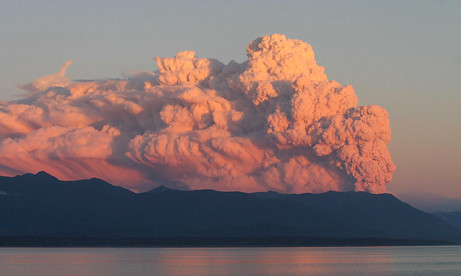
Chile Volcano erupting with Ash
Photograph by Alvardo Vidal/AFP/Getty Images)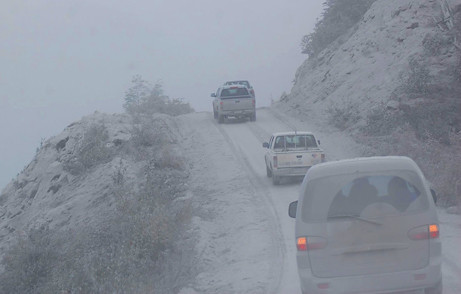
Chile Volcano, vehicles bathed in Ash
Photograph by Christian Brown/AP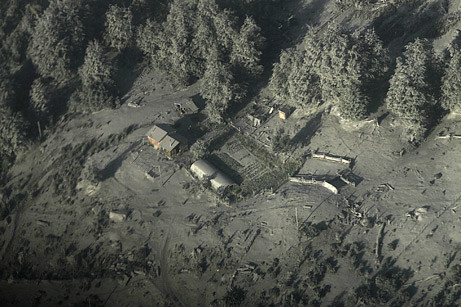
Aerial view shows houses, fields, and forest smothered in ash near Chaitén, Chile, after the eruption of the volcano
Photograph by Christian Brown/AP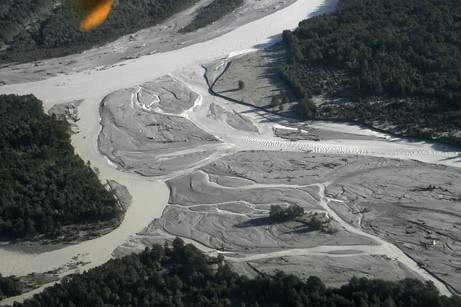
Ash covers the Yelcho River near Chaitén, Chile, on May 4, 2008, after an eruption of the Chaitén volcano
Photograph by Christian Brown/AP
Sunday, May 11, 2008 2
Wednesday, May 7, 2008
WASHINGTON, May 5 (Xinhua) -- As the global climate warms, many tropical insects face extinction unless they can adapt in some way, researchers in the U.S. Proceedings of the National Academy of Sciences (PNAS) reported Monday.
Insects are not able to control their temperature, which is dictated by the environment. All animals can live within a range of temperatures, but for each species, there is a "best" temperature not too far below the highest temperature it can tolerate.
Curtis Deutsch from University of California, Los Angeles, and his colleagues constructed "fitness curves," which show how life forms thrive or perish depending on temperature, for 38 species of insects from around the planet.
The researchers then compared how the insects fared in the late20th century and estimated the insects' survival probabilities based on climate predictions for the late 21st century.
The outlook is not good for tropical insects, particularly those near the equator, where insects are already living close to the maximum temperature for their species, according to the authors.
They predict that a climate warming of 2-4 degrees Celsius will likely kill tropical insects, along with other cold blooded animals such as frogs and lizards. Some may be able to evolve or migrate, but probably not all species, they say.
News Courtesy: China View
Wednesday, May 7, 2008 0
Monday, May 5, 2008
No one, but each and everyone of us are HEROs in saving the planet...
This short video gives an insight of what we can change...
This article embeds a video from YouTube. It may take time to load. Once you see the video press Play to watch the video.
Monday, May 5, 2008 0
This is a video from YouTube.
As it is an embeded video, this may take time to load. Once you see the video click Play to watch the video.
A Study warns.
NEW DELHI (AFP) — Asian vultures may face extinction in India unless a farm drug responsible for their large-scale decimation is banned outright, according to a report Sunday citing researchers.
The population of the oriental white-backed vulture has declined by 99.9 percent and the numbers of two other highly-endangered species by 97 percent since 1992 in India, a story in the Hindu newspaper said citing a study in the Journal of the Bombay Natural History Society.
The study had not yet been released on the society's website and the authors were not immediately available for comment.
Conservationists say the vultures are fast vanishing because of livestock painkiller diclofenac, which India banned in 2006 after it was found that the birds absorbed toxic amounts of the drug as they scavenged animal carcasses.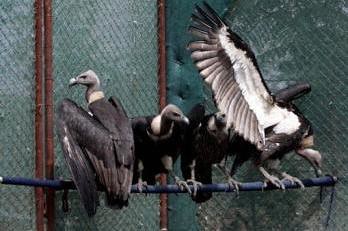
But despite the ban on the drug's manufacture, it is widely available, according to BirdLife International, a global partnership of conservation organisations, which also quoted the study in a post on its website.
"Time has almost run out to prevent the extinction of vultures in the wild in India. The ban on diclofenac manufacture was a good start but a ban on the sale of diclofenac and other drugs known to harm vultures is vital," said co-author of the study Rhys Green.
"Efforts must be redoubled to remove diclofenac from the vultures' food supply and to protect and breed a viable population in captivity," lead author Vibhu Prakash was quoted as saying by the organisation.
The researchers estimated the numbers of white-backed vultures at 11,000 from tens of millions in the 1980s.
The long-billed vulture population is believed to be around 45,000, while the slender-billed vultures number around 1,000, the study said.
The study recommended setting up three more captive breeding centres for vultures, apart from an existing facility in northern India to save the birds.
Last year, the centre bred two chicks in the first such effort in the world, but the birds died within a month.
The centre said that it would press on with its conservation efforts despite the setback.
In India vultures also play a vital cultural role. Followers of the minority Parsi faith depend on them for disposal of their corpses. They consider the burial or burning of human remains to defile the elements.

