
Tuesday, December 27, 2011
While most environmentalists and policy makers preach the importance of renewable energy and green practices, a primary school teacher residing in the dense forest near the Kaiga Nuclear Power Plant has actually gone a step beyond the rhetoric. He has put such mantras into practice to brighten his life.
The entire lighting requirement in his house, irrigation and domestic water pumps are all being operated on solar energy for the last 13 years. This has inspired many of his neighbours and fellow villagers to go solar. Nearly 60 per cent of the villagers now use solar energy.
Meet Narayan S Bhat of Shigekeri village situated in the forests of Kaiga, near Karwar. Like most of his neighbours, Bhat’s family has been making do without electricity, for generations now. Their only source of light, so far, were kerosene lanterns and oil lamps. However, the transformation came about in 1994, when Bhat was working as a teacher in Mundgod. “In one of the houses in Mundgod I happened to see a solar lantern in use. It was then that I decided to adopt this novel technology in my house as well,” says Bhat.
And then, there was light...
Way back in 1997, Bhat bought and installed a couple of solar panels to meet the lighting needs in his house. Over the years, he also bought direct current water and irrigation pumps and added more solar power panels. Everything from the dosa grinder and mixie in his kitchen to the TV, computer, telephone and fencing for his farm is powered by solar panels. He says that he has not experienced a single power outage in the last 10-12 years.
“We are nine of us in the family and also have many guests every day including labourers who work on the farm. A lot of cooking gets done in our kitchen and thankfully this technology has not failed us,” Bhat points out. Energy tapped from the sun is stored in batteries and used for operating lights and other appliances. When it rains though, there is no need to use the irrigation pump. The electricity that is generated is enough for our lighting and kitchen needs, he says.
School running on solar power
In fact, the government primary school adjacent to his house also uses solar power for lighting and to power the computer. Narayan Bhat, his wife Geetha and brother Ramachandra Bhat are also keen on community service.
Their house is always welcome for trekkers or naturalists who end up in the forest and have no place to stay for the night. The entire family and neighbours gather in the kitchen to cook food in case a large number of trekkers end up at their house. Bhat is popular with the students and their parents as well and has also won the Jana Mecchidanta Shikshaka Award, for his popularity. His school has also received the Uttama Shale Award. (Best School Award).
Read more here
Tuesday, December 27, 2011 0
Wednesday, October 19, 2011
This Do It Yourself (DIY) project will keep you thrilled.
Build your own LED light that consumes less power, and serves our purpose of lighting at dark.
The components required are:
This is what we built:
We used normal spotted LED's as we could not get hibright LED's.
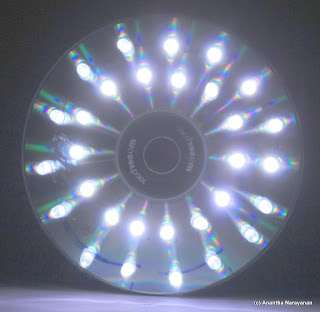

Build your own LED light that consumes less power, and serves our purpose of lighting at dark.
The components required are:
- Components Required: Hibright difused LED’s (preferably white) - 30 Numbers
- 0.33 MF 400V Capacitor - 1 Number
- 47MF 220V Capacitor - 1 Number
- IN 4007 Diode - 4 Numbers
- 100 ohms ¼ resistor - 1 Number
- Florotherm paper to fix LED (heat resistant upto 150 C)
This is what we built:
We used normal spotted LED's as we could not get hibright LED's.


Wednesday, October 19, 2011 0
Subscribe to:
Posts (Atom)
Do we really care about earth?
You are just visitor #
 who cares about our planet. Please remember to send the link to your friends to spread the word.


